

KEY FINDINGS › GLOBAL WORKSHOP SERIES

Blue Finance Workshop Series

A series of global workshops that bring safety into the blue finance conversation. Each edition is held alongside a major ocean conference and co-hosted with international partners, gathering governments, financial institutions, businesses, development partners and ocean practitioners to examine what prevents ocean opportunities from reaching investment — and to co-design the pathways forward.

WORKSHOP REPORT 01 · PDF
Unlocking Investment in Africa's Safe & Sustainable Ocean Economy
Our Ocean Conference 2026 · Mombasa, Kenya. Perspectives, seven barriers, pathways forward and conclusions.
DOWNLOAD THE REPORT
PDF · 55.7 MB · English
THE SERIES

One conversation, carried from conference to conference

Mombasa was a starting point, not an endpoint. Each edition extends the dialogue to another emerging ocean economy of the Global South, so that blue finance pathways are designed not only for these economies, but with them.

01
REPORT AVAILABLE
15 JUNE 2026 · MOMBASA, KENYA
Unlocking Investment in Africa's Safe & Sustainable Ocean Economy
Alongside the Our Ocean Conference 2026. Co-hosted with the World Resources Institute, the UN Environment Programme and the One Ocean Finance Facility.
Download the report
02
IN PREPARATION
APRIL 2027 · RIO DE JANEIRO, BRAZIL
Blue Finance for Safe and Sustainable Ocean Economies
Alongside the Ocean Decade Conference 2027, in partnership with BNDES and UN Global Compact Brazil. Taking the Mombasa pathways to Latin America and testing which are shared and which are context-specific.
03
TO BE ANNOUNCED
ASIA
Next edition
The series continues towards the Ocean Centres in Asia. Partners interested in co-hosting an edition can contact the Global Coordination Team.
Contact us
WORKSHOP 01 · MOMBASA

At a glance

An interactive co-design process rather than a series of presentations: high-level perspectives set the context, then two facilitated roundtable sessions explored challenges, opportunities and practical pathways.

11
SPEAKERS
6
FACILITATORS
THE QUESTION THAT STARTED IT

"How could African stakeholders come together to identify barriers to blue finance, co-design practical solutions, and connect global financing mechanisms with the realities and perspectives of emerging ocean economies?"

Nana Kwabena Boakye-Boampong, Country Lead, Ocean Centres Ghana
THE HEADLINE

"The challenge is not a lack of opportunity. The challenge is connecting capital to opportunity."
Hon. Emelia Arthur, Minister for Fisheries and Aquaculture, Republic of Ghana
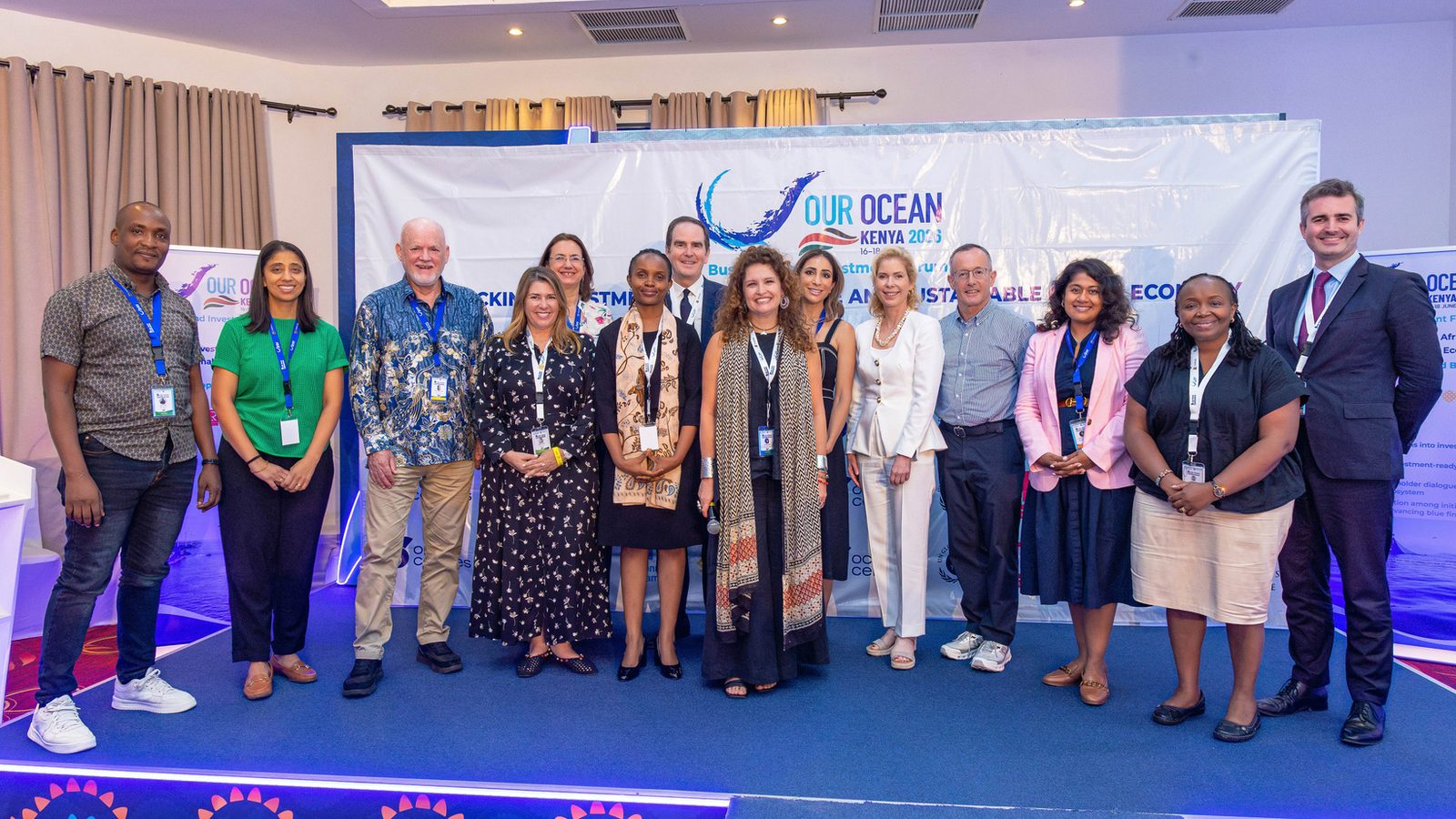
Participants of the Blue Finance Workshop in Mombasa
WORKSHOP 01 · VIDEO
Unlocking Investment in Africa's Safe & Sustainable Ocean Economy
Press play to watch · the video does not start automatically
WATCH

The workshop on film

Conceived by the Ocean Centres and co-hosted alongside the Our Ocean Conference in Mombasa, the workshop brought stakeholders from across Africa together with global finance actors. The film captures the perspectives, the roundtables and the question that ran through the day: how do we connect capital to opportunity?

Mombasa, Kenya Our Ocean Conference 2026 English
KEY FINDINGS

Seven barriers, seven pathways forward

There is no single blue finance gap. Investment depends on a chain of interconnected conditions — and progress at one stage is constrained when another remains unresolved. For each barrier the discussions revealed, participants co-designed a practical pathway.
1
From strategy to implementation
Strategies provide direction but not the full investment pathway; implementation requires prioritisation and ownership.
Pathway → Prioritise for implementation, define ownership, bring business and finance in earlier, and connect strategies to an investment pipeline.
2
Project preparation & investment readiness
The gap starts early: feasibility, validation and business cases are costly, and the support needed to become investable is itself underfunded.
Pathway → Invest earlier in preparation, create space to test and prove solutions, and develop dedicated preparation mechanisms.
3
Governance, regulation & institutional fragmentation
Fragmentation creates uncertainty; regulatory clarity matters as much as regulatory speed; coordination needs authority and accountability.
Pathway → Strengthen cross-government coordination, establish clear entry points, and streamline without lowering standards.
4
Data, knowledge & valuation gaps
Investment starts with knowing what exists; ocean value is not always visible in investment decisions; knowledge needs to travel between worlds.
Pathway → Strengthen ocean data and baselines, invest in evidence, develop shared indicators, and bridge knowledge between projects and finance.
5
Capital, risk & project maturity
There is no single ocean finance gap; not every investor can take every risk; risk needs to be allocated, not simply accepted.
Pathway → Match capital to project maturity, sequence sources of finance, use catalytic capital to bridge gaps, and allocate risk to actors able to carry it.
6
Scale, aggregation & connection to capital
A pipeline is not yet a portfolio; capital does not always see the opportunities that already exist; connection can happen at different levels.
Pathway → Build visible investment pipelines, aggregate smaller opportunities, and strengthen local and regional financing connections.
7
Access, inclusion & local value creation
Access is about more than capital; local actors need a role in shaping the pathway; investment should create and retain local value.
Pathway → Design finance for different scales and actors, build participation into project design, and strengthen local financial ecosystems.
CONCLUSION
Closing the blue finance gap requires more than capital. It requires an ecosystem that connects policy, projects, evidence, institutions, finance and local actors.
No single actor holds all the pieces. Creating spaces where these perspectives meet, challenge assumptions and co-design solutions is part of the enabling environment for investment.
THE FULL REPORT
Eleven perspectives, two co-design sessions, seven barriers and their pathways
With the closing reflections of Ambassador Peter Thomson, UN Secretary-General's Special Envoy for the Ocean: "We've got all the ingredients that we need. But perhaps we lack a more coherent way of bringing them together."
DOWNLOAD WORKSHOP REPORT 01